
Project
Warehouse Companion
Company
Oracle
Product / Domain
Data center supply chain / Warehouse operations
Role
Sole UX Owner, Principal UX Designer
Timeline
Fall 2025 – February 2026
Team
Oracle Application Labs, Oracle Datacenter Operations, Third-party Contractors
Methods
Field research, stakeholder interviews, process analysis, Design Thinking facilitation, workflow modeling, Figma prototyping, SME validation
Deliverables
Research findings, analytical deliverables, mobile workflow concept, Figma mockups, interactive prototype
Warehouse Companion was a mobile-first concept application designed to modernize the Pick, Pack, and Ship workflow used in warehouse fulfillment for Oracle’s data center supply chain. The application supported warehouse pickers from assigned work orders through item collection, barcode validation, packing, shipment documentation, License Plate Number generation, and final readiness for transport.
The project addressed a practical operational problem: warehouse workers were expected to move through a physical, time-sensitive environment while relying on tools that had been designed around desktop assumptions. Warehouse Companion translated that process into a guided mobile workflow, supported by AI-driven route optimization and item sequencing.

Enterprise operations often fail in the gaps between systems. A data center supply chain may have requisitions, inventory records, shipment labels, and transportation plans, but the work still depends on people moving through a physical warehouse and making dozens of correct decisions in sequence.
Warehouse Companion addressed that gap by treating Pick, Pack, and Ship as one continuous operational workflow. It gave pickers visible ownership, item-level status, barcode validation, exception handling, shipment documentation, and AI-supported route guidance in a mobile experience designed for the environment where the work happened.
Warehouse Companion turned warehouse complexity into operational clarity.
Project Context
Building a data center requires a complex chain of materials, suppliers, warehouses, shipments, and operational handoffs. Oracle did not manufacture every physical component used in these builds. Parts such as cables, server cases, racks, power equipment, networking components, and supporting infrastructure moved through a warehouse fulfillment process before reaching the data center site.
When a data center needed parts, it submitted a requisition request. The warehouse received that request, converted it into a work order, and assigned the order to one or more pickers. Pickers then collected the required items from warehouse shelves, brought them to a packing station or loading dock, packaged them, labeled the shipment, and prepared it for transport.
Warehouse Companion focused on this specific part of the flow: Pick, Pack, and Ship.
The goal was to give pickers a tool designed for the environment where their work actually happened: on foot, in aisles, around shelves, forklifts, pallets, boxes, labels, scanners, and time-sensitive orders.
My Role
The concept of Warehouse Companion began with my in-depth exploration of Oracle’s data center and warehouse operations. I visited an Oracle data center in Virginia in November 2025, met with the operations team responsible for data center infrastructure build-out, conducted recorded interviews, reviewed existing tools, and analyzed the workflows supporting supply movement from warehouse storage to data center delivery.
I also facilitated a Design Thinking-style exercise with the team. The intent was to move beyond known frustrations and draw on their practical experience to identify better ways of supporting the work.
To make the findings useful beyond the immediate project team, I turned the research into a strategic storytelling deliverable. In addition to the interviews, I recorded screen-capture walkthroughs of the existing warehouse software while operations experts demonstrated the workflow, and documented the data center and warehouse environment that shaped the work. I edited these materials into a video research documentary combining interviews, Design Thinking outputs, screen recordings, and environment exploration. The video helped socialize the findings with the broader UX organization and cross-functional senior leadership, including SVP and executive-level stakeholders. It also became one of the key reasons UX was invited into the subsequent week-long workshop to help reimagine the data center and fulfillment business.
In January 2026, I participated in a week-long workshop with Oracle data center specialists, warehouse storage experts, warehouse managers, and third-party contractors involved in data center construction. This gave me a broader view of the end-to-end process and allowed me to validate the Warehouse Companion concept against realistic operational scenarios.
For Warehouse Companion itself, I was the sole UX designer and owner of the user experience direction. I defined the mobile workflow, designed the Figma mockups, built the interactive prototype, and validated the concept with stakeholders who understood the warehouse environment.
90
PERCENT
Faster Data Entry
30-50
PERCENT
Faster Work Order Completion
Instant
Updates
Making Inventory
Real-time
The Challenge
The existing warehouse tools did not support the full Pick, Pack, and Ship workflow. The primary system behaved closer to a static inventory list than a workflow application. It was outdated, slow, desktop-oriented, and poorly matched to mobile warehouse work.Pickers relied on laptops in an environment where they needed to move through aisles, handle items, operate around equipment, scan labels, load pallets, and prepare shipments. Some parts of the process depended on third-party tools, spreadsheets, and manual coordination outside the main system.
Several pain points stood out during research:
- Pickers had little support for route planning through the warehouse.
- The system inventory did not always match physical inventory.
- Multiple pickers could work against the same order or overlapping items.
- Items could be picked more than once and left behind at packing stations.
- Packing required repetitive manual entry.
- Order state was not reliably visible across the process.
- Workers had to compensate for gaps in the software through memory, workarounds, and informal communication.
One example made the cost of the old process easy to understand. If a shipment contained 50 items and each item took roughly 30 seconds to enter or confirm, the worker spent about 25 minutes on data entry alone. That was time spent maintaining the system instead of moving the shipment forward.
The problem was larger than interface usability. The warehouse teams were compensating for missing workflow infrastructure.
Problem Statement
Warehouse teams responsible for fulfilling data center component orders needed a mobile, workflow-aware tool that could support order ownership, item picking, barcode validation, exception handling, packing, shipment documentation, and readiness for transport.
The tool had to reduce unnecessary movement, make work status visible, prevent duplicate picking, help workers handle inventory discrepancies, and support the realities of physical warehouse work.
Design Direction
Warehouse Companion was designed around a simple operational promise: help pickers know what to work on, where to go, what to collect, how to verify it, and how to prepare the finished shipment for the next stage of the supply chain.
The concept organized the picker’s work into a guided mobile flow:
Assigned order → Order review → Start picking → Guided navigation → Item validation → Quantity confirmation → Exception handling → Packing → Shipment photo → LPN generation → Completion
The design treated assignment, status, validation, and shipment tracking as part of the same experience. That was a deliberate shift from disconnected tools toward a continuous workflow.
AI as workflow optimization
Warehouse Companion was also a practical use case for AI in enterprise software without turning the experience into a chatbot.
AI supported the picker by optimizing the navigation path through the warehouse and recommending the most efficient order of items to pick. Instead of forcing the worker to plan the route mentally, the application could use the active work order, item locations, picker location, priority, and warehouse structure to guide the picker through the most efficient sequence.
The AI value was embedded directly into the work. It reduced unnecessary movement, supported faster picking, and helped the picker make better use of time without requiring a separate conversational interface.
Solution Overview
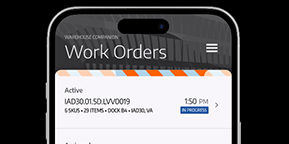
Work order visibility
The work order queue gave pickers a clear view of their assigned workload.
Orders were grouped by status and displayed with priority labels, requested completion times, and current state.
A picker could see which orders were assigned, active, packed, or ready for shipment.
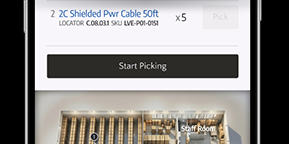
Activation and Item-level Progress
A picker could open a work order, review its contents, and start picking when ready. Once active, the order detail screen showed key information for each line item.
The interface supported multiple states at the item level. This made progress visible without requiring the picker to leave the task flow.
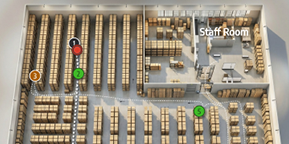
Location Guidance
Each item in the warehouse had a structured locator ID. Warehouse Companion used this, together with route optimization, to guide the picker through the warehouse rather than leaving them to search manually or plan the route on their own.
This was especially important in a large warehouse where inefficient movement could add significant time to every order.
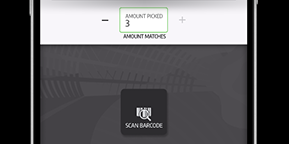
Barcode Validation
Barcode scanning shifted the picker’s work from manual data entry to validation. The picker would scan a barcode to confirm item identity, letting the system pre-fill known item details. The picker then entered or confirmed the quantity being picked.
A manual code entry option was included as a fallback for cases where the barcode could not be read.
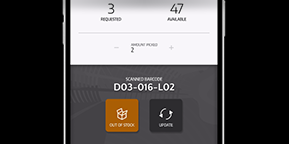
Exception Handling
The prototype accounted for imperfect inventory reality. Stock shortage and other scenarios were integrated into the workflow, allowing the picker to handle edge-cases. The line item would be marked as partially fulfilled, while the order could still continue through the workflow.
This preserved operational momentum without hiding the discrepancy. The system could then trigger follow-up action, such as replenishment or a later shipment for the remaining items.
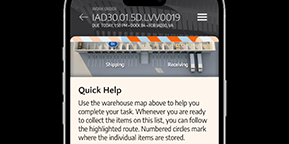
Embedded Quick Help
The design included embedded Quick Help within the order detail screen. This was especially useful for new pickers, contractors, or occasional users who needed guidance without leaving the task.
The intent was to reduce dependence on informal training and make the workflow easier to follow directly in context.
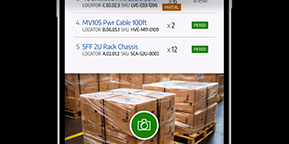
Packing and Shipment Documentation
After all available items were picked, Warehouse Companion guided the picker to the packing step. The picker could package the items, take a photo of the prepared shipment, and attach that photo to the work order as proof and reference.
This gave downstream teams a visual record of how the shipment looked before it left the warehouse.
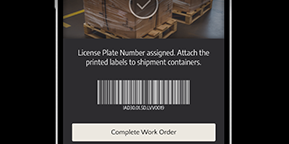
LPN Generation
The packing flow also introduced License Plate Number generation into the workflow. An LPN grouped multiple picked items under a single trackable shipment ID, such as a box, pallet, or shipment container.
Instead of tracking each individual item throughout transport, the system could track the LPN. The picker could generate the LPN, print barcode labels, attach them to the shipment, and complete the work order.
Impact Potential
Because I left Oracle before final implementation, these are not post-launch production metrics. They are based on research findings, timed task observations, prototype validation, and modeled workflow improvements.
90%+ faster item entry during packing
Timed research showed that manually entering each item into the legacy system took approximately 30 seconds per item. Warehouse Companion replaced most of that work with barcode-driven entry. Scanning took under 2 seconds, with manual code entry available as a fallback when scanning failed.
For a 50-item shipment, the legacy process could require roughly 25 minutes of data entry. With barcode-driven confirmation, the same item-entry task could be reduced to approximately 2 minutes, depending on scan conditions.
20–50% faster work order completion
The previous picking process had little meaningful route planning. Pickers had to search, backtrack, coordinate informally, or work without knowing whether another picker was duplicating part of the same effort. Warehouse Companion used AI-supported route optimization to recommend the order in which items should be picked and guide the picker through the warehouse more efficiently.
The estimated 20–50% improvement depended on order size, item distribution, warehouse layout, and how much unnecessary movement the old workflow created.
Inventory updates reduced from 10–20 minute delays to near real-time
In the old workflow, the system often was not updated until the picker returned to the dock and deposited the order. That created a 10–20 minute gap between physical inventory reality and system inventory. Warehouse Companion allowed item-level confirmation at the point of pick, reducing that delay to near real-time scan-based updates.
Interactive Prototype
For this portfolio case study, I rebuilt the Warehouse Companion prototype as a portfolio-safe interactive Figma demo. The embedded prototype shows the full Pick, Pack, and Ship workflow from assigned work order through picking, exception handling, packing, shipment photo capture, LPN generation, and work order completion.
Prototype Validation
The Figma prototype was reviewed and tested with warehouse managers and operational specialists during follow-up engagements. We used realistic scenarios to evaluate whether the workflow matched the practical needs of pickers and warehouse teams.
The validation focused on whether the concept supported the real work: identifying assigned orders, activating a pick, finding items, confirming quantities, handling partial fulfillment, documenting packed shipments, and completing the order for transport.
The feedback helped confirm the direction: a mobile, guided workflow could reduce ambiguity, support better coordination, and give pickers a tool better suited to their physical environment.
Outcome
Warehouse Companion produced an implementation-ready mobile workflow concept and interactive prototype for Oracle’s warehouse modernization effort.
I left Oracle before a final implementation decision, so I cannot claim production launch or shipped metrics. At the time of my involvement, the concept had been reviewed with data center and warehouse stakeholders, tested against realistic operational scenarios, and positioned as a candidate for implementation.
The work demonstrated how a fragmented, desktop-oriented operational process could be reframed as a mobile workflow with clear ownership, visible status, item validation, exception handling, shipment proof, and AI-supported route optimization
Reflection
Warehouse Companion reinforced a principle I consider essential in enterprise UX: complex work does not become simpler because software exposes more data. It becomes simpler when the product understands the workflow well enough to guide the user through the right action at the right time.The project required domain research, operational analysis, stakeholder facilitation, mobile UX design, and careful attention to edge cases. It also showed a practical use of AI in enterprise software: embedded workflow intelligence that helps people complete physical work more efficiently without forcing them into a separate conversational layer.
My effort produced an implementation-ready mobile workflow concept and interactive prototype for Oracle’s warehouse modernization effort.
The work demonstrated how a fragmented, desktop-oriented operational process could be reframed as a mobile workflow with clear ownership, visible status, item validation, exception handling, shipment proof, and AI-supported route optimization. For me, the value of the project was in turning a difficult operational process into a clear product direction: one that respected how warehouse work actually happens and gave pickers a focused tool for getting the right shipment ready, correctly and on time.